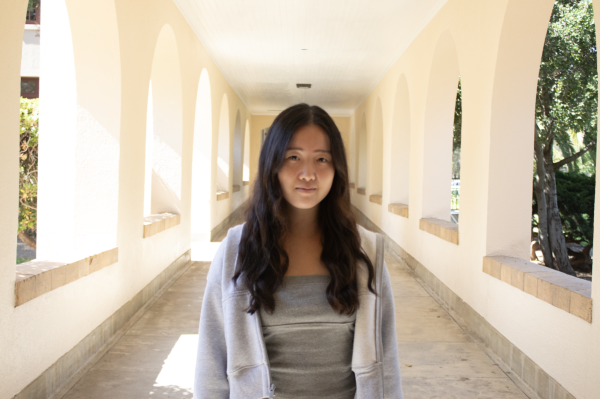

Behind a black metal fence, the blistering heat of the glassblowing furnace causes the crucible inside to emit an intense, yellow orange light. With steady wrists, senior Farrah Kardwell removes the blowpipe from the furnace and quickly rolls it along a polished brass surface to shape the glass. The lump of molten glass at the blowpipe’s end resembles honey, viscous and a shade of translucent, bright orange. Continuing to manipulate the glass to her vision, Kardwell repeatedly moves between reheating the glass, turning the pipe and cutting off excess with shears.
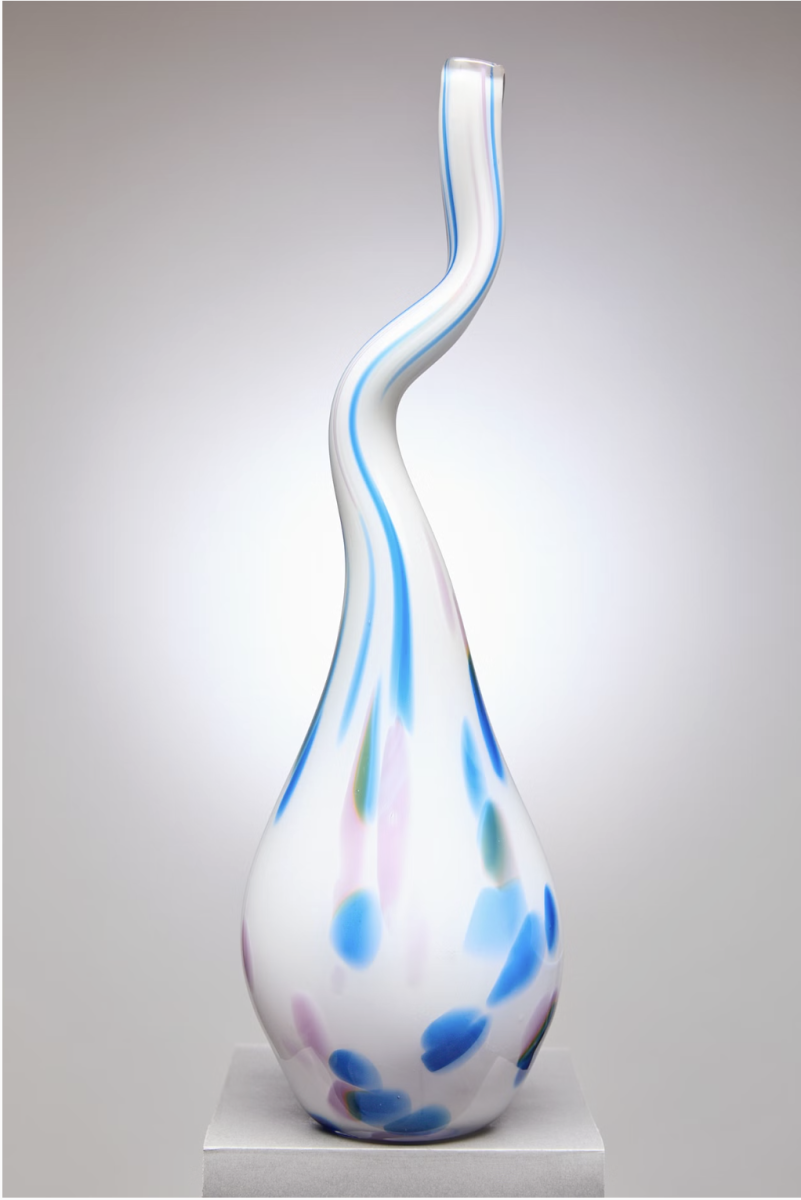
Kardwell is the most seasoned glassblower at Paly, boasting an extensive portfolio of glass projects from modern vases to sculpted human hearts. Before beginning to work with glass at the Paly shop, Kardwell’s first exposure to glassblowing was through watching the competitive glassblowing TV show “Blown Away.”
“I thought it [glassblowing] looked really cool, but I thought, ‘Oh, I could never do that,’” Kardwell said. “It looked so difficult. I never thought I would get to do glassblowing.”
Yet, her prediction turned out false; Kardwell was given the opportunity to work at the glassblowing shop during the Art Spectrum elective her freshman year.
“My teacher let us try it out a couple of times, and it was really fun,” Kardwell said. “They brought us outside and had us do the simplest kinds of things, like flowers.”
During her sophomore year, Kardwell continued on the 3D Art pathway and began taking ceramics class, where she had the opportunity to develop a strong foundation in glassblowing and experimenting in the furnace. Unlike ceramics, where projects sit for days, crafting molten glass challenges Kardwell to move quickly on her feet.
“You have to do everything you want to do in one sitting,” Kardwell said. “You can’t come back to a piece once it’s done; you have to cool it down, otherwise it will break. And it’s a lot quicker than ceramics, because you have to be working faster.”
With the temperature and time constraints of glassblowing, creating functional items and artistic sculptures requires the command of specialized tools and extensive teamwork.
“Every time I make something, I am always working with someone else,” Kardwell said. “If we decide to make a cup, there’s the person who’s actually making the cup. They will need someone to sit behind them and blow air into the glass and to shield them from the heat with a wood paddle. You also need someone to bring you tools and bits, pieces of glass that stick onto the glass bubble. Everyone knows what they’re doing and it’s easy to communicate and do what we need to do.”
The subtle dance of balancing many hands, molten glass and blasting furnaces led Kardwell to experience a steep learning curve in glassblowing.
“I couldn’t start making ceramics fully on my own until sophomore year,” Kardwell said. “It takes a lot of practice to even make a cup on your own. It’s definitely something you have to stick with for a while to get good and be self-sufficient.”
With completely new tools, and burning hot temperatures, Kardwell had to adapt to new techniques and rough conditions as a novice glassblower.
“People don’t realize how hot the furnaces are,” Kardwell said. “We load the pieces into furnaces of 2,000 degrees Fahrenheit. You’re standing in front of that and heating your creation. When I first started, I thought, ‘Oh, this is torture,’ but you get used to it.”
Alongside the challenges of high temperatures, glassblowing also requires patience due to the glass’s susceptibility to breaking.
“I’ve had many moments where I was working on something and then dropped it at the very end,” Kardwell said. “That was three hours gone. But all you can do is make it again. Practice makes perfect.”
This persistent attitude has allowed Kardwell to be creative and test out new projects without a fear of failure.
“I’m learning how to make human hearts right now for my AP portfolio. I’ve made a couple that didn’t break, but I just look at them and think, ‘Ooh, I want it to have more veins on it and valves, and so I’m going to do it again.’”
To stay persistent, Farrah has leaned on the support of her more experienced peers and mentors. She said Michael da Ponte, a Paly visual arts teacher and leader of the Fiery Arts Program, has been critical in running one of the only high school glassblowing programs in the country.
“He has definitely been the one to take control of the glass program,” Kardwell said. “All the new furnaces and reheating furnaces we have are brand new. Mr. da Ponte has been the best at helping everyone to get the proper equipment and teaching us how to create new glassblowing projects.”
With glassblowing requiring precision and a strong attention to detail, Kardwell found that insight and advice from older students in the Fiery Arts Program was also essential for developing her craft. In the same way, these valuable lessons have instilled in her the goal of guiding other students in the program.
“There were a lot of seniors who taught me,” Kardwell said. “Eli Crystal and his brother Zach taught me how to make my first flower, which was the first thing I ever made. Everyone who’s involved with the program has inspired each other. Now, I’m trying to do that too and be helpful for the juniors, sophomores and freshmen.”
The support that Kardwell received has led her to stick with the Fiery Arts Program throughout her four years of high school.
“There are only two people in AP 3D Art and Design this year,” Kardwell said. “The other person doesn’t do glass blowing, so I’m the only person in AP 3D Art and Design who’s doing glassblowing.”
As one of the most experienced student glassblowers at Paly, Kardwell has stepped up into the mentoring role guiding younger students with their first days at the furnace.
“There’s a lot of literally holding their hands when they’re holding the tools,” Kardwell said. “For example, you always have to be turning the pipe when you’re working. Eventually, the goal is that they can turn the pipe and use a tool at the same time.”
Kardwell has passed down her knowledge to fellow students but the fruits of her glassblowing labor spreads into the broader community.
“I’ve gifted so many glassblowing creations for birthday presents and Christmas presents,” Kardwell said. “They always appreciate that so much more than if you were to buy something. They can really appreciate the amount of effort that went into the pieces.”
Kardwell knows that the opportunity to create beautiful glass art is uncommon, especially for high school students, making the Paly program especially unique.
“I’m glad that Paly put so many resources into the Fiery Arts Program because it’s not a cheap or easy thing to run,” Kardwell said. “I’m grateful that we have that. We’re one of only two schools in California that have glassblowing studios on campus.”
Along with it being rare at high schools, glassblowing is an increasingly unique artform because glass is made by hand.
“AI can’t do glass blowing,” Kardwell said. “It’s cool that glassblowing is something that only humans can do. We’re all using screens now. Glassblowing is now extra special because it’s very tactile.The College Board art portfolio now has all this screening that goes into it because they think kids are using AI for digital art. You can’t do that for glassblowing.”
Through continuing to handmake glassware, Kardwell carries on the tradition of combining art with practical techniques, creativity and attention to detail, all from the human mind, something she hopes to continue in the future.
“I would love to start a glassblowing club at whatever college I end up going to,” Kardwell said. “It is hard to get that kind of thing started because you need people who already have experience.”
As the end of Kardwell’s senior years nears, she hopes that the Paly Fiery Arts Program will continue strong.
“More people should get involved with Paly’s glassblowing program,” Kardwell. “You can do glass, filming and ceramics. A lot of people at Paly will only take one year of art, or two years, but it’s really cool to be a part of it just for fun.”
Beyond the art form, Farrah’s experience glassblowing has extended into life lessons in all aspects of her life.
“Glassblowing has taught me that under enough heat and pressure, something fragile can become strong,” Farrah said.