While juggling between work, studies and parenting, Stanford transfer student Summer Wahab learned her SNAP benefits were about to get delayed. Time is on the line, as she has to brainstorm different solutions to bring food back on the table. Tomorrow, Wahab doesn’t know if she can feed her children. In Silicon Valley, one of the wealthiest zip codes in America, a single mother was left with the dilemma between paying rent or buying groceries. And she is far from alone.
“I just felt really sick inside,” Wahab said. “I’m already struggling as a single mom in such a wealthy school and neighborhood. I felt like I was failing my children because I didn’t know what to do, I didn’t know where to go or who to talk to, and I don’t wish that on any parent to lie in bed and just look at your children and not know how you’re going to be able to feed them properly.”
On November 1, 2025, the U.S. Department of Agriculture (USDA) informed states that federal funds for November’s Supplemental Nutrition Assistance Program (SNAP) — a program that allocates funds to low-income households for the purchase of eligible food through an electronic benefits transfer card (EBT) — would be delayed if the recent government shutdown continued. Though California and other states slowly restored their benefits, the process may take up to a week for all services to be reinstated. In the meantime, millions of families were left without the assistance they rely on to buy groceries. Wahab is but one of millions of Americans affected.
“When I found out the EBT was getting delayed, I broke down because I already struggled so much to put food on the table,” Wahab said. “Just knowing I wasn’t going to have that [resource], I didn’t know how I was going to live or get through things.”
Childcare for just two of her children costs around $6,000 a month, causing the lack of government resources such as SNAP to be detrimental for her situation.
“It [SNAP] was super vital in my life to help me with groceries so I don’t have to figure out if I have to choose one bill over food,” Wahab said. “Do I choose to buy food on this day, or do I choose to pay my rent?”
After moving from San Francisco to Palo Alto in order to continue her education at Stanford, Wahab felt lost, isolated and unaided by the area, as there seemed to be a scarcity of essential assets for low-income parents to receive any type of help.
“There’s a lack of resources here for parents in general or low-income individuals,” Wahab said. “I really didn’t know where to turn. I didn’t know who to talk to. I reached out to all these places and nobody could help me.”
These federal support programs, such as SNAP, help ameliorate dire situations for families and individuals all over the country, not just for a select few.
“Having benefits from SNAP was extremely beneficial to my family and so many [others] across the US,” Wahab said. “This is the way that puts food on people’s tables. We have veterans, we have disabled [individuals], we have families, children, those in foster care. SNAP benefits really do help those that don’t have that extra support.”
SNAP is just the first domino to topple. Across the country, federal defunding is affecting other public systems just as much, including the media outlets Americans depend on for trusted information. The Rescissions Act, signed into law on July 24, eliminated approximately $1.07 billion in funding towards the Corporation for Public Broadcasting for fiscal year 2026. Public media is a nationwide system of 1,600 television and radio stations serving 99% of U.S. households. For smaller stations, especially in rural locations, federal funding is their lifeline, with some up to 30% of government funding making up their revenue. Without this support, the fate of these stations is in an urgent condition. Michael Isip, president of San Francisco’s PBS and NPR member station KQED, says the cuts threaten more than programming budgets.
“It’s not just about PBS or NPR or local stations like KQED, it’s about the risk to the community,” Isip said.
An estimated 115 public TV and radio stations — many in rural areas already struggling with weak broadband and the lack of local news — could shut down within two years.
“It is well documented that we’re already in a local news crisis, so there’s a decline in local news sources and a corresponding growth in what they call ‘news deserts,’” Isip said. “When people do not have access to local news and information, they are less informed, they are less engaged and voter turnout declines.”
As more and more news stations around the country are to be shut down, the future of the historical American democracy is at risk.
“An informed, engaged, participatory society is the foundation of a strong democracy and a healthy society,” Isip said.
A significant factor impacted by the Rescissions Act is the decline of education for younger audiences. PBS’s preschool program, which is free to 52% of 3-to-4-year-olds who do not attend formal preschool, is one example. Broadcast infrastructure keeps communities educated and safe, and apart from delivering television and radio programming, they also deliver emergency messages. Without these systems, communities lose more than just entertainment. Instead, they lose timely emergency alerts, early-childhood education and the reliable local reporting that democracy depends on.
When imagining future generations not being able to experience shows like Sesame Street and Clifford the Big Red Dog, it is becoming clear that cuts to public media are not happening in isolation.
The same pattern is unfolding in healthcare, where federal funding directly shapes whether low-income families, seniors and high-risk patients can access essential care.
Funding for government nursing homes, hospitals, dialysis centers, Medicare Advantage and Part D plans all run on a star-rating system determined by the Centers for Medicare and Medicaid Services (CMS). This rating regulates the work of doctors, rewarding higher overall quality as the result of successful treatments instead of paying by the quantity of admitted patients. Annually, CMS will run different measures against different programs, and the amount of extra funding is determined by the rating.
According to a healthcare engineer who has worked at companies including Humana and Teladoc and requested anonymity, recent regulatory changes have made it harder for smaller healthcare providers to achieve high CMS ratings. Without sufficient funding as a consequence of tighter rating restrictions, smaller providers may withdraw from Medicare and Medicaid due to difficulty in maintaining profit margins.
“If the government defunds healthcare corporations, the coverage benefits are going to change. Premiums will increase and coverage of service will reduce, which results in more out-of-pocket costs for people needing care,” the healthcare engineer said. “Those with chronic diseases — diabetes or hypertension — have to take medicine consistently, regardless of income. These are the people who are truly in danger.”
If underfunded healthcare raises questions about America’s commitment to its most vulnerable people, the situation at NASA raises questions about the commitment to a sustainable, long-term future for humanity.
A senior scientist at NASA’s Jet Propulsion Laboratory (JPL), who also requested anonymity, said the consequences of cutting back funds towards space exploration and climate preservation are already visible.
“NASA’s budget was cut from $25 billion to $18 billion … and in particular, [the federal government] was going to cut at least more than 50% to 53%,” the NASA scientist said. “Recently JPL laid off 550 people, in addition to more than 850 layoffs last year.”
The cuts have canceled several nearly finished space and environmental projects, including climate-change research and the Mars Sample Return mission.
“This is a big loss to the [field of] science,” the NASA scientist said. “The Mars Sample Return mission was canceled altogether, and the Mars Rover has already collected samples on the surface of Mars, so we [only] needed to bring the sample back.”
The return of the samples would bolster scientific understanding of the Red Planet, laying the foundation of humanity’s first step on Mars.
In addition to the termination of the Mars Sample return mission, projects that directly benefit Earth research are shutting down as well.
“The two satellites we were ordered to end [the orbit of] include the Aura satellite and the OPERA satellite [project],” the NASA scientist said. “Those satellites have been in orbit successfully for many years. If you [take them down], that means no more Earth observations.”
The Aura satellite, launched in July 2004, is a NASA mission focused on studying the Earth’s atmosphere, as it measures gases like ozone, carbon dioxide and pollutants to monitor air quality, whereas the OPERA satellite project detects surface water extent and vertical land motion. When an increasing number of observing satellites such as Aura and OPERA shut down, progress towards climate change prevention and the hope of an eco-friendly society is jeopardized.
“Climate studies receive [tiny amounts of] money,” the NASA scientist said. “For example, the National Oceanic and Atmospheric Administration (NOAA) only has $2 billion [from their budget] annually to do everything.”
The NASA scientist sees a clear trend: Over the past two decades, the federal science program has been losing both strength and purpose.
“JPL and NASA altogether are in decline and the decline is very rapid compared to 20 years ago,” the NASA scientist said. “We are already not as strong as a laboratory as before.”
The greatest challenge isn’t the difficulty of scientific research itself, but the politics and social forces surrounding it. This is why people become the last line of hope when government programs and fundings are cut. When hardships surge in numbers, help is needed more than ever.
“NASA is in trouble, and science research is in trouble,” the NASA scientist said. “Somebody has to fix it, and it’s the younger generations. In 10 years I’m going to retire, so who is going to run NASA? Who is going to continue science?”
Across science, media and public service, the message is the same: Challenges are real and developing, but this is not the end. The true importance lies in the shared belief by those who strive to keep hope and human compassion alive — that the future still belongs to those willing to fight for it.
“We’ve been defunded by this administration; this is not the end of threats and challenges we face,” Isip said. “We need to develop the next generation audience, the next generation of supporters who want experiences, different forms of content and ways of storytelling.”
At their core, federal programs are meant to fulfill essential public needs: Educating the nation, assisting families with limited resources, and supporting research that helps ensure humanity’s long-term future.
“[KQED is] independent, noncommercial media, which exists to serve and inform the public so they can be active, responsible participants in society,” Isip said. “That’s essential, so we will endure.”
Such resilience is rooted in the people who continue to believe in public media.
“The thing that gives me hope is how our business model is based on individuals — people who voluntarily give because they value what we do,” Isip said. “And for KQED, we have a little more than 252,000 members, and their contributions make up 60% of our budget.”
There is work to be done, but as long as the united and supportive community unfalters, progress can be made.
“If we can continue to deliver on our public service, I know we’ll be able to earn and re-earn the trust, the faith, the belief and the financial support of our community,” Isip said. “So it’s really the fact that we’re powered by the community and we are an essential service that gives me hope.”
As public media looks to its community for support, many Americans also have each other to rely on. Alley Torres — a Palo Alto resident and a mom of three children — stepped up to help as much as she could for those people in need of emergency food supplies.
“It was really weighing on me when I heard that the SNAP program was going to be paused,” Torres said. “I grew up in a family that benefited from programs with a single mother, and so it really saddened me. I could see how people would go hungry, especially with the fact that a lot of people, by the time we’re coming to the end of the month, their SNAP benefits are already gone.”
From the strength of this heavy emotional turmoil, Torres decided to take things into her own hands.
“I was sitting around feeling like I was unable to make any changes or do anything for people who are in need, and that has been the entire presidency under the current administration,” Torres said. “My kids have this little lemonade stand, and so I was like, ‘How do we feel about just putting out some food that we already have?’”
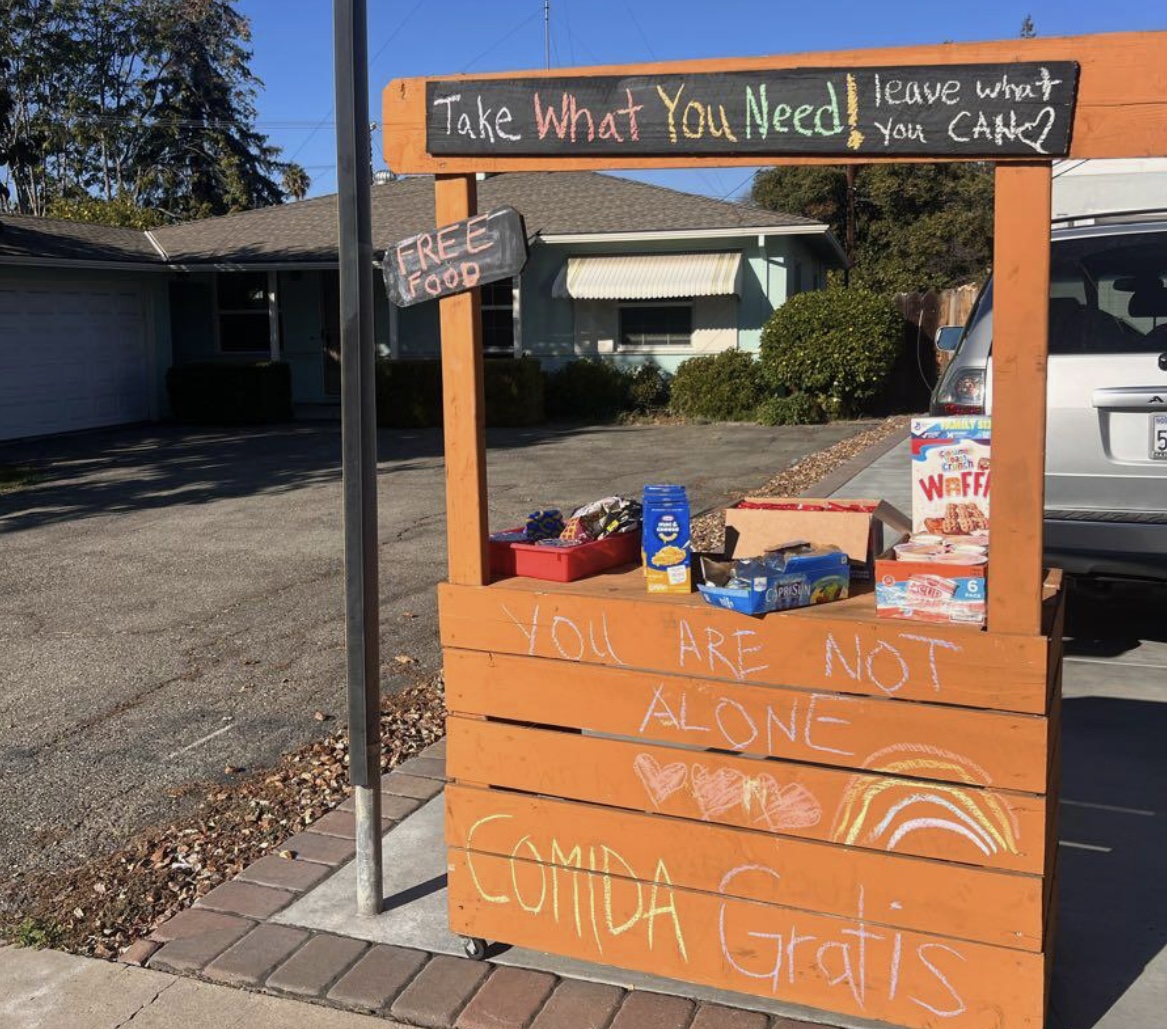
Near the sidewalk of Torres’ driveway stands a welcoming and colorful wooden lemonade stand full of groceries and emergency food, with a sign reading: “Take what you need, leave what you can.” Due to her house being next to a busy bus station, where people walk past the table frequently, Torres observes heartwarming interactions one after another.
“We got an envelope from some anonymous person with $100 in it,” Torres said. “And then another lady stopped by, and she was like, ‘Can I just donate?’ She told me that she had grown up on food stamps, and she’s a nanny of two younger children, and that she really just wanted to help out because she knows how hard it is to get kids fed.”
The ability for a community to gather together and support one another is astonishing. Torres’ next-door neighbor, a senior citizen on a fixed income, donated hand-picked persimmons from his own tree.
“People are trying to do whatever they can to help each other and I think that speaks volumes for the kind of country that we all want to be living in,” Torres said. “We’re surrounded by good people.”
The most striking moments came from people who were struggling themselves.
“Two older women came from Venezuela as refugees,” Torres said. “They [said], ‘Thank you so much, this is so helpful. We’re going to make some meals with this food and then give it to our neighbors too, because they’re in the same situation.’ They’re in need, but they’re still giving, which I just think is just so inspiring and so beautiful.”
In the end, for SNAP recipients like Wahab, the local community united together to help her endure.
“It wasn’t until I took it to Nextdoor [a common platform that connects neighbors in proximity] to ask the community where I can get help and I let them know my situation,” Wahab said. “The community gathered together and gave me every resource you could think of: where I can get food and pick up groceries.”
Although current federal policies and changes are significantly affecting the lives of Americans, there still is hope.
“I’ve had neighbors come and drop off groceries to my home. I’ve met them at their houses to donate a bunch of groceries to me,” Wahab said. “I’ve also had somebody drop off gift cards to me for food. And if it wasn’t for this community within Palo Alto, Menlo Park and Redwood City, I don’t know what I would have done. This community saved me.”