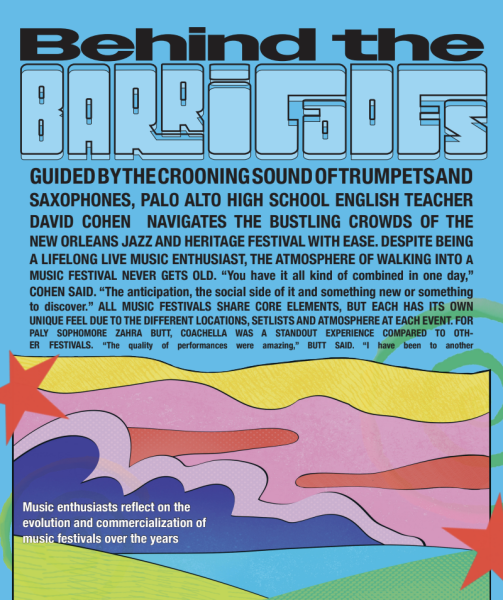
 Guided by the crooning sound of trumpets and saxophones, Palo Alto High School English teacher David Cohen navigates the bustling crowds of the New Orleans Jazz and Heritage Festival with ease. Despite being a lifelong live music enthusiast, the atmosphere of walking into a music festival never gets old.
“You have it all kind of combined in one day,” Cohen said. “The anticipation, the social side of it and something new or something to discover.”
All music festivals share core elements, but each has its own unique feel due to the different locations, setlists and atmosphere at each event. For Paly sophomore Zahra Butt, Coachella was a standout experience compared to other festivals.
“The quality of performances were amazing,” Butt said. “I have been to another festival and Coachella definitely topped all the ones I’ve heard about and even the one I had gone to.”
Beyond just the musical performances, Butt also appreciated the cultural significance that Coachella had, bringing back memories from a decade ago. These events create the opportunity to connect over shared memories.
“The unicorn frappachino was there, artists and songs that were popular during that time, and the outfits were so 2016,” Butt said. “It really made me feel nostalgic for the era because, even though I was young, I still remember the music and fashion.”
However, not all music festivals are designed to cultivate the same atmosphere as Coachella. They are flexible experiences intended to be shaped by each individual who attends and their musical preferences.
“I would say that the culture and the vibe at different festivals vary,” Cohen said. “You can still find some of the more low-key experiences for people who just want to enjoy the music.”
In more recent years, especially, this percentage of audience who are in attendance just for the music has decreased. Music festivals have become more about the full package, such as the improved food and drink selection, rather than purely about the music performed there. There have been major increases in food selection and areas such as VIP lounges that make the festival experience more enjoyable for attendees looking for entertainment alongside the music performances.
“I think for a lot of the audience, music is the cornerstone of it, but it’s not the whole thing,” Cohen said. “I’m sure there are a lot of people who would go if the ticket prices were different, or if [they] had a friend from out of town or out of the country, and were like, ‘Come on, let’s find something fun and special to do.’”
While music festivals may be a rare event for some, others choose to attend them more often, despite the impractical conditions. Many find that the memories they create and experiences they have make these impractical conditions worth it and continue to attend festivals.“Everyone’s tolerance for discomfort, extreme lines, extreme temperatures or extreme crowds [is] going to vary from person to person,” Cohen said. “I get the appeal of putting yourself through something and getting the reward.”
Despite the extreme circumstances, many are still drawn to the payoff. At the same time, there has been a shift in recent years toward a greater variety of food, drink and other amenities that enhance the experience.
“I’ve seen [the shift] to some extent in the years I’ve been going more regularly,” Cohen said. “There’s more emphasis on the food and drink experience [and] more gourmet food trucks.”
In addition, many events, music festivals included, are now starting to put together tiered ticket systems to improve the experience for those willing to pay more.
“Even just regular concert venues are starting to put together more VIP packages, where you can listen to the sound check, get a photo and a signed poster,” Cohen said.
Paralleling the increase in ticket tiers and commercialization at these events, the ticket prices have also risen. This trend was noticed by Paly sophomore Lucia Davis.
“The ticket prices have definitely increased, and it is so expensive to go to music festivals now,” Davis said. “I don’t really have a problem with the ticket tier system because you can have a great experience with either general admission tickets or VIP.”
The ticket tier systems not necessarily being a negative aspect of events such as music festivals is reflected by Jasper Thrun, a senior at Gunn High School and self-made music producer. However, there are still a few downsides to the system.
“I think it makes sense for the event organizers to have ticket tiers, especially for higher-paying fans, as it gives them the option to stay away from bigger crowds,” Thrun said. “It kind of sucks as an attendee, though, since a VIP area next to the stage will usually take away space or view from the general audience.”
That tension highlights the competing priorities in tiered ticketing. Paly economics teacher Eric Bloom sees the VIP options as a practical way to refine the experience for those who can pay more.
“The idea is that you’re willing to pay a little bit more for a [VIP] ticket because you’re going to get more,” Bloom said.
The economic benefits of tiered ticketing expand beyond audience management and experience. Festival organizers also rely on these systems to help cover operational costs of festivals.
“A festival has higher startup costs because you have to bring everything there,” Bloom said. “Having a venue is expensive, and you have to fill the call, book acts, get people to come in and [again on] Tuesday, Wednesday and Thursday when no one’s there.”
To make up for these expenses, many music festivals have transitioned from purely music-based celebrations to more all-rounded commercialization opportunities in recent years.
“Originally, music festivals were a cheaper alternative to concerts, as they would combine many into one larger event,” Thrun said. “But modern music festivals are [now] dominated by sponsors, which help pay for the artists and event setup.”
Despite this, ticket prices continue to increase. To some attendees, the significant rise in price makes it not worth the expense for the experience.
“They [ticket prices] are absurdly high for what you’re getting,” Thrun said. “I think it would be justified if every buyer was a fan of every single attending artist, but that’s just not true for anyone.”
Despite the economic imperfections, festivals can be a substantial way for smaller artists to advertise and showcase their talents, potentially increasing income later in their career.
“Festivals are great for smaller artists since they get to expose their music to new audiences, and usually grow their fanbase doing so,” Thrun said.
Social media coverage of music festivals also helps listeners explore new genres. Short moments from performances can go viral and live streams and official coverage provide global access.
“I think social media has been great for listeners, since it greatly increases accessibility to these shows for most,” Thrun said.
In addition to smaller artists sharing their songs, there has also been a significant amount of influencers posting about their own experiences at festivals. While the increase in influencers makes the atmosphere more prestigious, it also makes viewers and fans want to go even more.
“The amount of influencers I see posting about festivals, specifically Coachella, is crazy,” Davis said. “I feel like a lot of them are just going for content and clout and not necessarily to enjoy the music, which definitely changes the experience for normal people.”
Although social media can take away from the authenticity of music festivals, for Cohen, the full package offered by experiencing live performances is unmatched, and the same feeling cannot be found online. The anticipation leading up to a set and the dynamic between the performers and the audience cannot be replicated through a screen.
“The best days for me have been [when] I arrive totally psyched to see one of my favorite bands,” Cohen said. “Maybe [it’s] because I’ve already seen them, and I know how good it’s going to be, or [because] I’ve never seen them [live].”