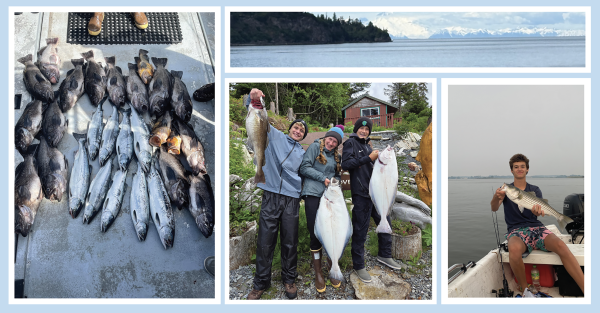

The fishing boat creates soft ripples across the calm ocean, whose wave patterns are occasionally disturbed by a leaping fish, a smiling dolphin or the splash of a whale surfacing for air. The boat, along with its passengers, drift in a world of complete peace, interrupted only by curious sea creatures who inhabit this Alaskan sea.
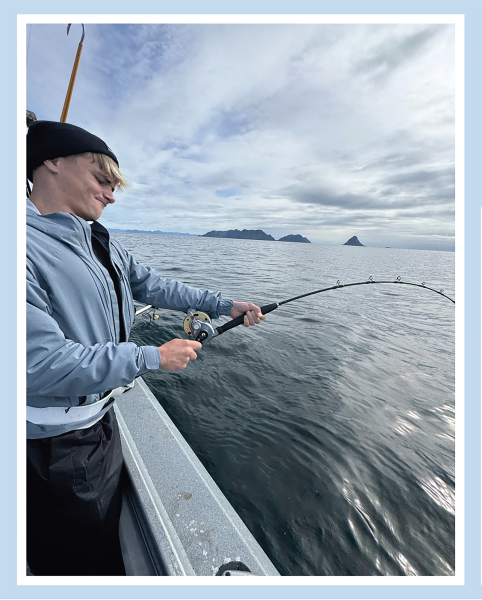
The soft chatter on the boat is interrupted by an abrupt ringing of a bell, signaling that one of the passengers’ fishing rods has caught onto something. Paly junior Jensen Craig springs to his feet to check the rod, and he finds one fish — weighing over 100 pounds — thrashing in the water.
“The fight to get the fish up [onto the boat] took 45 minutes,” Craig said. “The fish bounce and wriggle around, and once they get that big, they can really do damage to a boat or a person. Once we got it to the boat, our captain used a boom stick, which is a PVC pipe with a bullet on the end that they stab the halibut [with]. [Then, they] shoot it in the head so that they can pull it on the boat without risking any harm.”
The experience of fishing in the pristine Alaskan wilderness and catching such coveted fish is one that Craig will continue to cherish.
“It just felt like the zoo out there; we were catching massive fish,” Craig said. “It was the surrealness of the whole scene itself, rather than the fishing, [that] … made it really special.”
But moments like these are becoming increasingly rare, as growing threats to marine populations put these remarkable areas at risk and can halt even the most sustainable fishing practices. Originally from San Diego, Carissa McClure has spent the past three years majoring in Global Environmental Science at University of Hawai’i Mānoa, where
she conducts research in biogeochemistry — the relationship between living organisms and their environment. From her time in the lab to her real-world experience in this field, the damaging effects of commercial fishing on aquatic ecosystems have become alarmingly clear.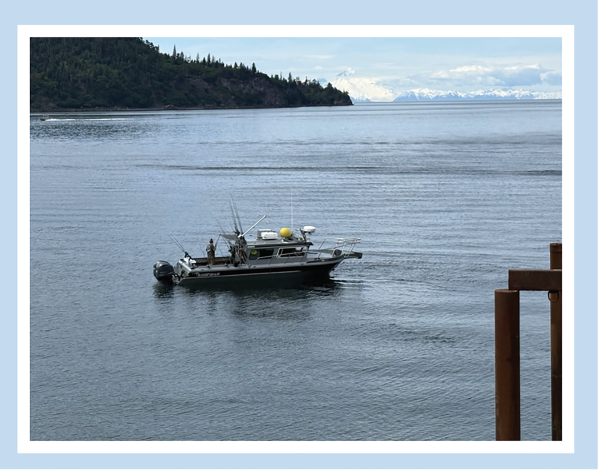
“Commercial fishing can be very harmful to ocean conservation efforts typically because overfishing happens, which causes populations to be thrown off, and this has a negative effect on trophic cascades,” McClure said.
Trophic cascades, the damaging ripple effect caused by taking the top animal out of its ecosystem — such as those caused by overfishing — pose significant threats to ecological communities.
“Food webs and the interactions that different animals and organisms have with each other are the basis for keeping a stable environment or ecosystem, and overfishing causes a major disruption to that environment,” McClure said.
Unfortunately, the impact of overfishing extends beyond targeted fish species, as commercial fishing practices often rope in other marine life as well.
“Another downside to commercial fishing is ‘bycatch,’ which is when the fishers catch anything that isn’t the target species of exactly what they’re trying to fish for,” McClure said. “They can catch marine mammals, other fish or sometimes even sea birds.”
In McClure’s eyes, it is especially important to stay mindful of a fish’s well-being, which is generally a low priority for commercial fishers when catching-and-releasing.
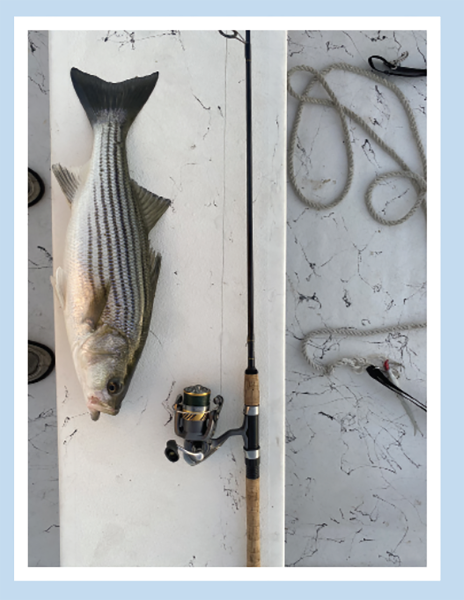 “Catch-and-release [fishing] can actually be harmful because humans can be causing pain and stress to the fish from it being hooked, handled and brought out of the ocean,” McClure said. “This can cause a delayed death in the fish from shock. On the other hand, catch-and-release can be a very gentle and sustainable way of fishing because it keeps populations constant, and you aren’t directly taking the fish out of their ecosystem or environment.”
Despite harmful fishing practices, fishermen often have a strong interest in conservation and hold deep knowledge of the best ways to fish. Shaped by his dad and grandfather’s past experience as fishermen, Greene Middle School English teacher Craig Bark understands the vital role fishermen play in protecting the environment that surrounds them.
“Fishermen often provide most of the data used to make conservation decisions, as they are the ones who find and catch the fish,” Bark said. “Researchers will be at the launch ramps or docks asking fishermen for data that they record and use to make decisions about limits, seasons and regulatory zones. Fishermen, for the most part, are the most conservation-minded people.”
 While these sustainable fishing practices help contribute to scientific research, they also deepen the personal connection to nature of fishermen like Bark.
“The fishing itself can be exciting,” Bark said. “You learn to deal with success and heartbreak. It’s also a great learning experience. Fishing does involve luck sometimes, but [the] fishermen who learn to read the water understand the patterns of the fish and the way weather affects those patterns will always catch more fish than the person who just goes out without any knowledge.”
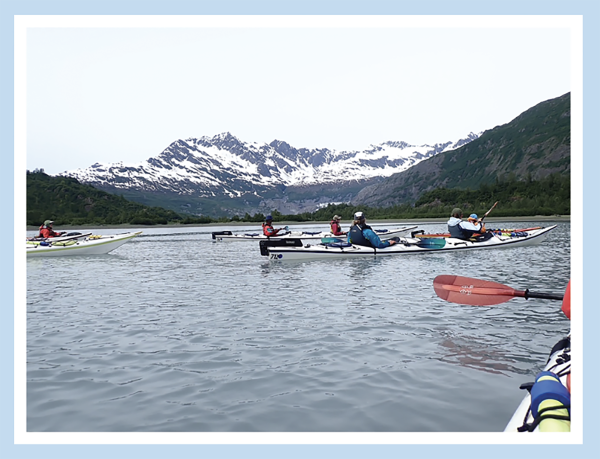
The challenging yet thrilling nature that Bark describes is something many fishermen cherish, regardless of their experience level and age. Junior Nava Schwarzbach was captivated by the excitement and adrenaline of fishing after casting her line for the first time while participating in NOLS — the National Outdoor Leadership School.
“[NOLS] is a program that a lot of people at Paly do,” Schwarzbach said. “In Alaska, it’s super easy to get a fishing license. For our program, we signed up, filled out some documents and then picked the duration of the license.”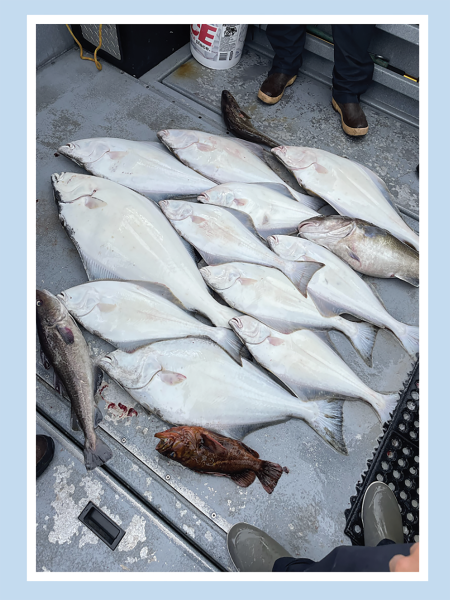
During her time with NOLS, the principles of zero waste were engraved in Schwarzbach’s mind. Her program emphasized mindful fishing practices and sustainability.
“We were only allowed to keep as many fish as we could eat, so whatever we couldn’t, we had to release,” Schwarzbach said. “If we caught 10 fish one day, we were only allowed to keep four and everything got eaten. In Alaska, you do not want leftover fish because of bears, so everything gets eaten.”
Aside from hungry bears, another challenge of travelling through the Alaskan backcountry was learning how to adapt to fire as the only available method to cook fish.
“We used the coals [to cook], and it made the fish have a smoky taste, like a bonfire without any seasoning,” Schwarzbach said. “We were in a state park when we caught all these fish, and there are specific ‘Leave No Trace’ guidelines to build these fires so that they are not bad for the environment and don’t have a ton of human impact.”
These wildlife preservation techniques help NOLS participants learn new skills of which they had previously been unaware. For Schwarzbach, this learned skill was cooking seafood.
“One guy was actually a chef, and he took butter, brown sugar and soy sauce and made a glaze,” Schwarzbach said. “One of the girls learned how to fillet fish.”
Far from the spectacle of Alaskan open water, Craig’s love for fishing developed through his dad, who grew up fishing in Puget Sound, Washington.
“[My dad] always had a love for saltwater fishing,” Craig said. “But when he moved [to Palo Alto] in college, there was not a lot of good saltwater fishing around. So, when he was raising me, he raised me on fresh water fishing.”
Many of Craig’s fondest childhood memories come from the seemingly smaller moments he spent fishing with his dad.
 “Whenever we went hiking together, we would bring a fishing rod because there would always be a little lake at the top,” Craig said. “Gradually, I just kind of found my own enjoyment from [fishing].”
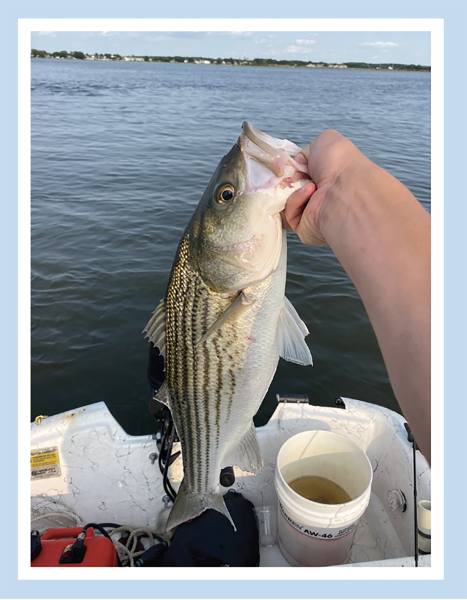
When fishing locally, Craig typically goes to Foothills Park or Arastradero Preserve, where the repetition of continuously casting for largemouth bass has helped Craig find a deeper meaning beyond catching fish.
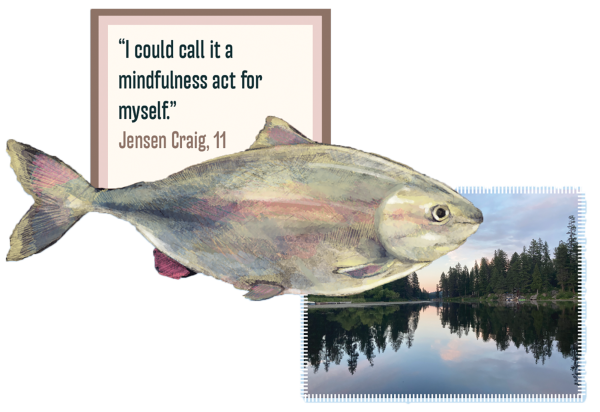
“The thing that affects people the most is the calmness [of fishing]: You learn patience,” Craig said. “More often than not around here, I go out, I cast and I don’t get a fish. Something about it is calming, and it’s a way to get into my own space, especially when you’re on a pond or a little lake. It’s pretty beautiful. I could call it a mindfulness act for myself.”
The long hours Craig and his father have spent waiting for a catch gives them more time together — time during which Craig’s father taught him to maintain patience while out in nature.
“I used to get frustrated when I didn’t catch a lot of fish,” Craig said. “My dad used to always say, ‘There’s a reason it’s called fishing, not catching.’”
Junior Myles Allen has also found fishing to be an exercise in patience, especially after moving to Palo Alto from South Carolina. The slower pace of open saltwater fishing in the Bay Area forced Allen to adjust his expectations when casting.
“I never fished saltwater in South Carolina, and when I moved here, it was pretty hard to get into because there’s a lot more space than fresh water,” Allen said.
Moving has also shaped McClure’s exposure to the marine world. After growing up by the beach in San Diego and moving to Hawai’i, McClure has witnessed the repercussions of careless fishing practices while diving.
“Lots of times when I’m diving, I see a bunch of fishing weights and lines that are tangled around rocks and the reef,” McClure said. “People [should] make sure to pick uptheir trash and not leave all of their lures, weights and lines at the beach or near the ocean.”
By respecting the environment, both experienced and newer fishermen can enjoy the grounding aspects of the experience while mitigating the harm caused by careless fishing practices. In fact, it’s through the sense of peace created through fishing that many people, such as Bark, have explored unique aspects of nature and created invaluable memories.
“We would take my grandfather’s boat up and camp for a week and fish everyday,” Bark said. “There is always a drive or a road trip to get there, which leads to great conversation and time spent looking at the scenery. Fishing helps create great relationships because you spend a lot of time in beautiful places with people you care about. Most people don’t get to see the sunrise or pods of dolphins in the thousands from a boat 100 miles offshore.”