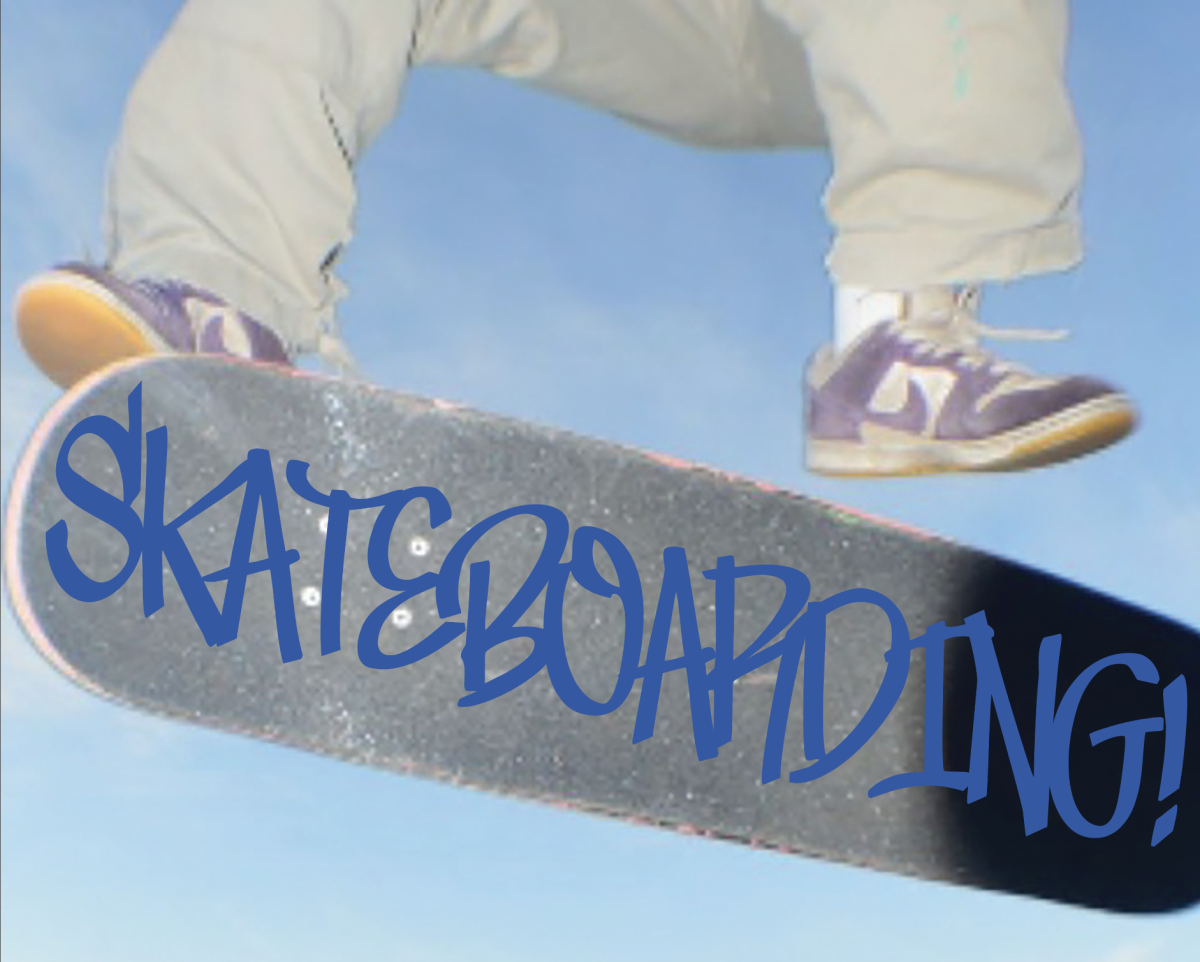

Color was everywhere. Neon Hydro Flasks tucked into the water bottle holders of pastel Fjällräven backpacks. Waves of crowds lined up to pose by the iconic hot pink wall in Los Angeles, a popular locale for Instagram posts. The world felt like it was in constant motion, from the penny boards on which people teetered to the constant flicking of fidget spinners. The oversaturated food dye from slime somehow managed to make its way onto all clean surfaces, leaving stains that still stubbornly stick to this day.
Together, these memories of seemingly frivolous everyday activities and trends form the kaleidoscope that has come to represent the 2016 era for many, taking a rise with the new year. Junior Vanessa Martin has recently seen an influx of videos with people embracing the 2016 aesthetic, wondering if this nostalgia will color the rest of the year.
“I’m interested to see if any of the old trends are going to come back, kind of how all the old songs are coming back,” Martin said.
However, given the increased attention to the year, junior Dylan Wilson has witnessed 2016 being portrayed on social media as a much simpler time.
“People [keep] saying ‘take me back to 2016’ paired with nostalgic songs,” Wilson said.
Many are looking to rewind time, to experience that same unbridled joy and easy living they had in 2016. But, while this simplified image may be a comforting product of nostalgia, author Charlotte Lieberman said the depiction of 2016 painted by social media does not encompass everyone’s true experience.
The Brooklyn-based writer who has written and researched the psychology behind retroactive romanticization has seen the complexities of nostalgia in the human brain through her studies to become a licensed therapist.
“Nostalgia tends to be comforting to people, and it’s a form of escapism,” Lieberman said. “Your memory is always being informed by where you are in the present. Anything you’re remembering consciously is a byproduct of how you’re coming to that act of remembering.”
Additionally, her experience has helped her develop a deeper, scientific understanding of memory, learning how the human brain allows nostalgia to become a source of solace for many.
“Your memory is not just there to help you find your keys or your car or tell the doctor when your birthday is, all the ways that we use memory constantly,” Lieberman said. “There are certain cognitive biases that have evolved to make us feel better by remembering.”
One such process is retrieval induced forgetting, which Lieberman describes as the brain suppressing negative connotations paired with an event and instead favoring the positive recollection. Junior Ivanka Kumar has noticed that this memory distortion is present in the portrayal of 2016 in popular culture.
“2016 had its own problems, for sure,” Kumar said. “But for most of us, we were kids. We only remember the time as a very joyful time in our lives. So, right now, we want to bring back those elements.”
In addition to becoming increasingly more selective over time, memory also has the ability to become more forgiving. An example is a cognitive phenomenon known as fading affect bias, in which unfavorable experiences diminish to allow good memories to intensify, according to Lieberman.
This is a recurring pattern in which students reflect more fondly on their own experiences from their childhood. When junior Chris Jeon reminisces about his life from a decade ago, there is a special emphasis on the carefree, offline days of adolescence, viewing it in a more positive light than the childhoods of kids today.
“My favorite memory from 2016 is probably, in elementary school, playing with my friends on the playground during recess,” Jeon said. “I would like to see kids actually spending time outside and having real interactions [in 2026] instead of being on iPads and phones all day.”
Similarly, senior Isaac Telyaz has his own fair share of memories from 2016 that also remain rooted in simplicity.
“I actually don’t really remember if it was all that good,” Telyaz said. “I remember being really happy though, and stress-free. Because I was young, I didn’t really care about anything. … All I had were my friends and my family. School wasn’t hard. I don’t know if it was the same for high schoolers at the time, though.”
For some high schoolers at the time, their memories were just as warm. Lia Salvatierra, a Paly graduate from the Class of 2019, memories of 2016 have remained largely positive. She attributes this feeling to being a sophomore in high school, when the academic stress had not yet set in.
“I just remember … the world felt pretty bright,” Salvatierra said. “There were a lot of new and exciting things specifically happening around the Bay Area that were really fun to participate in. There were a few new festivals at Shoreline.”
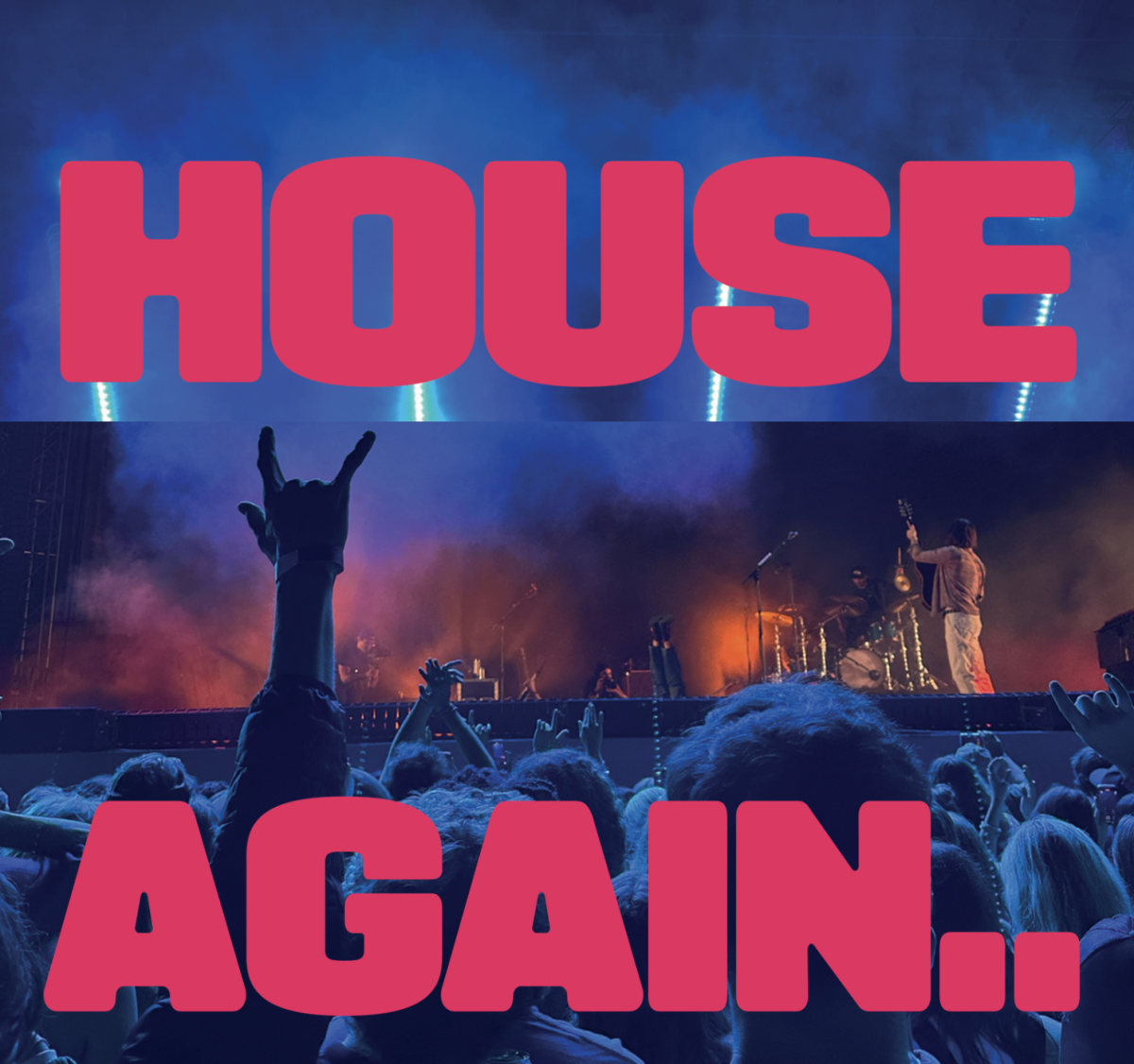
Beyond Live 105 BFD, an alternative rock festival at Shoreline, another exciting development in 2016 was group video calls.
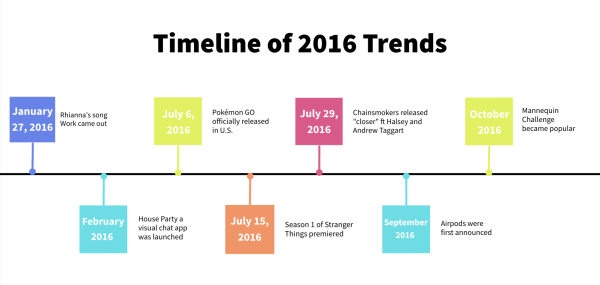
“There was this app called Houseparty [where] you would basically be … in a group FaceTime with your friends and also strangers, and people would pop in and out,” Salvatierra said.
Although the Houseparty app was often open to strangers, the majority of Salvatierra’s peers chose to be more private on platforms such as Instagram because it was seen as a safe place for presenting your personal life.
“It felt like the internet was being used for less evil [in 2016],” Salvatierra said. “The biggest thing was the fact that it wasn’t endless. You followed who you followed, they posted what they posted, then you looked and it was over. Now, it is just endless content and paid content in ads. I mean, there were no ads back then. It was really just for engaging with people you knew.”
English teacher Bekki Casalco, who was earning her bachelor’s degree in English language and literature in 2016, has also seen a shift in how social media operates.
“Regardless of what is presented, [trends are] constantly changing,” Casalco said. “Now people are trying to be this certain aesthetic or this certain look. Back then, it was just really dependent on your personality, who you were.”
The character Casalco noticed in people’s online presence relates to the unique sense of community she observed through 2016 trends.
“It was easier to make friends, and it was easier to connect with other people, because there wasn’t this idea of trying to fit into a specific thing or trend,” Casalco said. “The trend was just being yourself.”
Math teacher Quinn Basewitz said the genuine intentions behind earlier trends described by Casalco have slipped away over time.
“Now, in terms of social culture, everything is so curated, [and] people present more of an artificial representation of themselves,” Basewitz said.
One popular 2016 trend that Basewitz enjoyed was the mannequin challenge. The videos would pan to people frozen in place and were typically accompanied by the song “Black Beatles” by Rae Sremmurd and Gucci Mane, Basewitz said.
That feeling of unity and fun created by trends like the mannequin challenge is a major proponent of why Basewitz believes people are so determined to relive this era.
“People are feeling nostalgic for what felt like an easier time, when there was less chaos in the news,” Basewitz said. ”Now people are thinking back to that time ten years ago, which felt so much simpler, and that’s why some of the trends are coming back.”
While this time is remembered for its playful trends and bright aesthetics, Wilson has noticed a more serious side to 2016 that is often glossed over.
“It’s a unique circumstance that we have the same president [who was elected] in 2016 that we do now,” Wilson said. “I feel like that’s why a lot of things are similar. But I think things are definitely a lot more intense right now than in 2016.”
As a second grader during the 2016 presidential election between Hillary Clinton and Donald Trump, in which Trump was elected to his first term, Wilson recalls her life, at the time, being filled with political discourse.
“I remember a lot of my classmates were really scared going into November and the later months during the election,” Wilson said. “They knew everything going on from their parents and what would happen if Trump got elected. I remember I would always tell my friends, ‘There’s no way he’ll be elected.’”
For Wilson, the election increased her political awareness and steered her mind away from childhood trends such as fidget spinners and slime.
“When Trump won, it was very heartbreaking,” Wilson said. “Since we were so little, we didn’t really know what was going on, but we knew from our parents and the news. … We just knew something was not going well.”
The confusion Wilson experienced due to her young age was less prevalent in 24-year-old Bradley Shultz’s recollection of the election results, a high school freshman in 2016.
“People around here thought Trump was a joke and were shocked when he was elected,” Shultz said. “Some people took it harder than others, too. I remember my history teacher came to school dressed in all black the day after the election, and then a few days later put up a map showing how Hillary won the popular vote.”
Shultz has noticed that the biggest discrepancy between his experience witnessing both Trump presidencies is the dramatic change in political polarization.
“Back then, the vibe on both sides was ‘the other side is an idiot,’” Shultz said. “Now, it feels more like, ‘the other side wants to destroy our country.’”
The division Shultz has noticed growing throughout the years has not gone unnoticed by younger generations. Despite her young age in the 2016 election, junior Kate Lindstrom shares a similar feeling to Shultz
“I assume a lot of the time that everybody that I talk to has the same political opinion as me,” Lindstrom said. “However, when I do see signs of somebody supporting an opinion that I don’t personally believe in, it just seems so glaring. Things have gotten so polarized that it’s hard to say that anybody is really in the middle anymore.”
Lindstrom attributes much of this heightened polarization to the way that political news and information are consumed.
“Social media is a huge part of politics nowadays, which honestly is a little bit frightening because social media is a place where there’s so much misinformation and so much dramatization,” Lindstrom said. “There are a lot of stories I hear that come only from social media.”
Junior Jack January has also seen politics intertwined in social media, often feeling this presentation is more of an aggressive approach compared to usual news outlets.
Similarly to his fellow Paly students, January said, in 2016, he perceived an overall sense of fear from his classmates regarding Trump’s upcoming presidency. Yet, January did not share the same interest in political tensions as many of his peers.
“I didn’t see it affecting me in my personal life, and I didn’t see a reason to start disputes with others if I had differing opinions, which I felt I did,” January said. “My reaction was really neutral, because I didn’t think that … [women’s right and immigration policies] were going to affect people as much as they thought they would.”
Through Trump’s two terms, January believes that — contrary to people’s original worries and claims surrounding women’s rights and immigration— these perceived fears never fully manifested. Despite this observation, he has noticed and experienced an increase in hostility towards the Republican party.
“I see more anger, more outrage, and I don’t think there’s anything inherently wrong with that, because people … should be allowed to be mad,” January said. “But what I do think is wrong is when we are hurting people and we are damaging our relationships with others based on politics.”
Katie Harbath, a political analyst who began her career in the early 2000s working on political campaigns, notes that this political tension was overlooked amid an overwhelming amount of support from both sides for their preferred candidate.
“Prior to November, or even the first half of 2016, people were really excited [about the upcoming election],” Harbath said. “There was the assumption that we were going to have our first female president, and we were coming off of Barack Obama, who was still president.”
For some, that sense of optimism quickly faltered after the election results rang out, leaving behind a bitter taste many people discount when remembering the year in a nostalgic view.
“People were not expecting that,” Harbath said. “People were wondering how it was that [Trump] had won, why he had won, how that had happened. It was a real change, and set the tone [in which] we’re, frankly, still in today. Our politics [have become] a lot more polarized, and [we are] dealing a lot more interference [and] disinformation.”
Harbath highlights that 2016 was also a turning point in the relationship between politics and online platforms, as the rise of social media was entering a new territory. But, in her opinion, this polarization did not emerge overnight.
“Studies show that people were already moving to different neighborhoods that had similar political affiliations to themselves,” Harbath said. “You already had it in the media environment, even going back to the ‘80s. Republicans, when they started talk radio, were starting to create their own media ecosystems.”
For example, Harbath said a large number of candidates and citizens were using Facebook, Instagram, Youtube and Twitter to communicate.
Political discourse continues to infiltrate the online world to this day, which students like Wilson do not see as an inherent negative.
“Politics is everywhere in the media, especially in social media,” Wilson said. “Because of this, I think a lot of people are more aware of what’s going on in the world, and it has encouraged more conversations about it.”
One particular conversation that has remained a pressing topic in the news over the course of the decade is the one surrounding immigration, which Harbath has seen evolve dramatically since 2016.
“There’s always been somewhat of a concern about how many undocumented immigrants might be coming across the border,” Harbath said. “But what I’ve seen is [that] it’s gone from a positive conversation of, ‘OK, this is not great, but what can we do to try to make a path to make it better?’ versus now it’s much more on the negative side.”
Harbath acknowledges that immigration strategies were far from perfect, but she saw more international cooperation to tackle global issues such as climate change. Similarly, Marine Biology teacher Margaret Deng believes that 2016 advocacy movements, such as “Save the Turtles,” showcased a real community effort to make a difference.
The collective effort paid off in October 2025, when the International Union For Conservation of Nature took green sea turtles off their endangered species list.
“‘Save the Turtles’ in 2016 definitely did [create real change],” Deng said. “For example, protective anti-net legislation has been helping in Florida, [and] there have been positive trends in the numbers of sea turtles and slowly the populations are recovering.”
The main positive takeaway Deng has observed from these trends is the increase in climate awareness since 2016, specifically in younger generations. However, Deng has drawn a distinct line between different climate conversations over the years among her own generation.
“When the movement was just getting started, people were starting to become aware that we were destroying our planet, and people actually were trying to do things,” Deng said. “We were more optimistic [about climate change] in 2016.”
For that same reason, Deng has observed a decrease in climate coverage, making her believe that no one sees the urgency behind climate-related issues.
“There’s a lot less [media] about climate change these days,” Deng said. “The list [of climate-related issues] continually grows, but no one feels urgent about it anymore, which is really sad.”
Deng believes this lack of gravity surrounding climate issues cannot be tackled by individual actions alone.
“[Politicians need to] put climate change as one of the top things on their agenda,” Deng said. “In 30 years, we won’t have a planet to live on if we keep going. So, people should be looking more long-term than short-term. It will cost a lot of money. Companies are going to get really, really mad. But because we live on the planet, we should definitely prioritize it.”
Deng claims that everyone can create a positive impact on climate change, even if one is a student.
“Donating is definitely the number one thing,” Deng said. “Being able to educate yourselves and other people on it is going to really help, because if you don’t have that urgency, nothing’s going to get done. It’s all just going to be sitting in somebody’s slush pile.”
Climate change is one of many topics that have never fully faded from the past decade and are now seeing renewed attention. As conversations about both serious issues and lighthearted trends reemerge in 2026, students like sophomore Delany Vahdat are debating what aspects of 2016 are worth reviving.
“I do think that we idolize [2016] in a sense, but I think that we’re going to idolize anything,” Vahdat said. “I wouldn’t say it’s [an] accurate [representation of 2016] because social media only highlights the good. That’s what is inducing the nostalgia of 2016.”
2016 is often remembered for the brightness its viral trends brought. But underneath that initial glare remains many underlying political and economic tensions. Lieberman suggests that nostalgia allows for the glorification of the superficial aspects of 2016 keeping the serious matters behind the scenes.
“A unicorn latte is just a unicorn latte,” Lieberman said. “A unicorn latte can’t shed light on a presidency or the problems within it. The way that nostalgia is leveraged in fashion or digital culture — that’s going to just be the highlight reel, the positives of that particular time.”