
The honking of cars pans from ear to ear. Students from all over Palo Alto hoist their handmade signs in the air — chanting, shouting, hollering — in protest against the U.S. Immigration and Customs Enforcement (ICE) on Jan. 30, 2026, and reflecting the First Amendment right at a time when their meanings are increasingly debated nationwide. When fundamental freedoms find themselves under threat, civic engagement can extend much further than protests at Palo Alto High School. Junior Julia Curtis advocated for 24/7 active crossing guard supervision on Feb. 4, 2026, a petition that has gained over 3500 votes. Students also bring their concerns directly into institutional processes, as senior Dylan Chen spoke against a handful of district decisions during the Feb. 10 board meeting.
Moments like these highlight the enduring influence of the country’s founding ideals as the United States approaches the 250th anniversary of its founding this year. The rights embedded in the Constitution — from freedom of speech to the right to assemble and petition — continue to shape how Americans can push for reform. The United States Semiquincentennial marks a milestone in the nation’s history, creating a moment for people to reconsider how the ideals of liberty and rights are understood in America today.
As a history teacher and Paly Social Justice Pathway instructor, Ken Tinsley has had several opportunities to reflect on the founding documents and their influence on the course of American history. One document in particular — the Declaration of Independence — has guided our country since its creation.
“We looked at the Declaration of Independence and all its themes and ambitions from that lens … seeking pursuit of happiness, equality, all those things,” Tinsley said. “Taking a really old document that might feel disconnected from our time today and making it relevant now [is] really what’s important.”
Since the last signing of the Declaration of Independence, the upbringing of democracy and freedom at the time leaves social science teacher Stephen Foug astounded by its democratic ideals.
“I had to be reminded or taught this over and over just to understand how much of a risk [writing] the Declaration of Independence was,” Foug said. “It’s [the Founding Fathers] expressing their opinions on humanity to the highest power in the world at that point. When you start talking like that, I get inspired again by the idea of America. I’m back to that city on a hill.”
The American eagle, a symbol of freedom and strength; the Statue of Liberty, representing opportunity and refuge; and the Constitution, the document that embodies individual rights and representation, pieces together what is considered the majority of the values associated with the word “America”. The fundamental symbols of this nation have developed into the embodiment of a set of principles centered on liberty, diversity and equality. These ideals still impact the foundation of what the country is built on, even to this day.
To understand where these principles originated, it is necessary to trace back to the intellectual movements that preceded the founding of the nation. During the 17th and 18th centuries, new revolutionary principles emerged across Europe. This period of time introduced new ways of thinking about art, philosophy and politics — many of which were unprecedented, according to Britannica. The development of novel values such as individual liberty and natural rights challenged the traditional order of hereditary monarchies and divine authority present in Britain and other European empires, a sentiment later included in the Declaration of Independence. Enlightenment thinkers like John Locke argued that a government’s political authority ultimately derives from citizens themselves, a concept unique to America that was eventually adopted into the Constitution, as other countries back then ruled with antiquity and monarchy in mind.
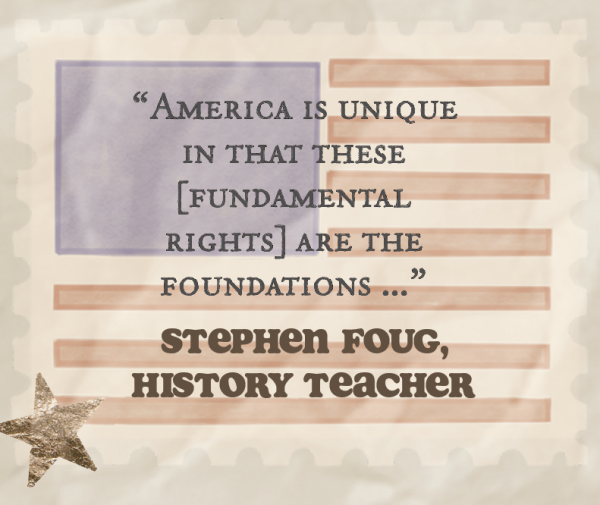
“America is relatively unique in that these [fundamental rights] are the foundations on which we create this government,” Foug said. “I am in awe of the founders’ brainpower.”
However, the U.S. has notalways been a place where freedom serves as the cornerstone of the nation. Analogous to other 17th-century societies, the British North American colonies were structured by rigid social hierarchies that restricted many groups of people.
“The original formula [was] not perfect, but [it was] a turning point,” Foug said. “[It was] a watershed moment in human history of that much mass participation in a government at that scale.”
Thus, the Founding Fathers set in motion a political experiment that would gradually reshape ideas about rights and governance. Brian DeLay, a U.S. History professor at the University of California, Berkeley, has studied how this then-new system has bolstered the idea of individual rights in America. Compared to most countries of the 18th century, particularly those in Europe, this framework differed significantly from the way most societies were organized at the time, according to DeLay.

“There’s no inherent privilege, there’s no aristocracy and there’s no institutionalized church [in America],” DeLay said. “Neither the Catholic Church nor the Church of England has any kind of formal political power in the new United States, and that’s a really important advance in the history of democracy and liberty.”
While the founding documents introduced values of liberty and equality, librarian Sima Thomas said these principles were limited in terms of how broadly they could be applied in the context of the era.
“[The founding documents] were aspirational,” Thomas said. “They were structurally limited in their acceptance of the institution of slavery. However, I don’t think it has to be [limited] because we understand now that the way we treated indigenous people and the institution of slavery were all barbaric.”
The support of an institution such as enslavement is often seen as hypocritical and ironic. The United States, a country built on the values of independence, natural rights and liberty, found itself protecting a system of enslavement that contradicted all of such ideals. While the U.S. rejected being a part of the British Empire, they were also participating in imperial tendencies.
“A political system that says there’s … a fifth of the population who, by virtue of their skin color and the location of their ancestors, are going to be treated like property is a really hideous and intense form of imperialism that the United States was committed to,” DeLay said.
Not only did the Founding Fathers benefit from enslavement — many of whom owned plantations — the experiences Native Americans faced were similar. It’s crucial to recognize that through exploitation and abuse, the original British colonists used the Native Americans, their land as well as their resources.
“The entire sort of fiscal premise of how this new policy was going to actually sustain itself, fund the government and generate wealth for its citizens was dependent on the progressive displacement of the original inhabitants of North America, and that is absolutely an imperial project,” DeLay said. “The new United States’ wealth depended upon the displacement of native people and the commodification of their land.”
The laws and regulations that made up the foundation of America had their flaws, likely influenced by the fact that they only reflected the perspective of a narrow group of people in power. America began as a republic largely governed by an oligarchy of white, wealthy men that represented only a small proportion of the population, according to DeLay.
However, DeLay said that expanding inclusion under the law has been key to the nation’s evolution and has been shaped by movements such as the Civil Rights Movement from 1954 to 1968, which spanned from the Brown v. Board of Education Supreme Court decision to the Montgomery Bus Boycott. This enabled more groups to participate in governance and shaping a society that more closely reflects its founding principles.
“Starting in the 1950s and finally culminating in the 1960s, we have a third American republic: a multicultural democracy where we actually do have a system, though it’s certainly imperfect,” DeLay said. “Still, we nonetheless inhabit a Republic where citizens are equal before the law, regardless of whether they’re men, women, white or not white.”
This transformation pinpointed a turning point in how the United States understood itself, broadening inclusiveness to those long excluded from its promises, a transformation that reached for the multicultural democracy that we have as of now.
“With the Constitution and the Declaration of Independence, it’s this declaration of wanting to be better,” Tinsley said. “This pursuit … is not going to be perfect, but we want to try to, as people, get together, organize, collaborate [and] make change. That’s our right as Americans.”
Over time, the meaning of the principles outlined by the Declaration of Independence has been expanded by successive generations, ultimately reinterpreting and applying more inclusive doctrines to reflect a broader and more inclusive definition of “liberty and justice” than that of the original American oligarchy.
“[It’s] the life, liberty and justice for all,” Thomas said. “For all, really meaning for everyone that’s here, not just who someone decides gets it. This should be for women, for transgender people, for immigrants, for everyone of every background, every persuasion and every religion.”
While it may not necessarily be a reality, this promise of freedom for all has certainly inspired individuals all around the world to immigrate for a fresh start and new opportunities. Thomas’ father, for example, moved from Iran for a chance at education and a better life for his family, according to Thomas. Not only do these individuals bring themselves to America, but they also bring their identities, cultures and perspectives, all of which create a richer country together. Stanford University’s Global and U.S. history professor Gordon Chang researched just how important this factor is.
“The country is much better because of its diversity through immigration,” Chang said. “It is a fact of life, and our social and political practices need to keep up with the demographic change.”
The community of Palo Alto, known for its diverse backgrounds and perspectives, contributes to how individuals form their identity and understand what it means to be “American”.
“Growing up in this multicultural place like Palo Alto is one of the impacts of growing up here,” Thomas said. “But [this is] American to me; this whole idea that we can make something new [together], and we can imagine something better.”
As an immigrant who moved to the U.S. in 2023, junior Jannie Long knows firsthand what it feels like to be an outsider who has to readjust to a new, unfamiliar country. However, this cultural separation hasn’t stopped her from discovering her community and place in America.
“I can find many people who share my cultural background, including other Chinese and Asian people,” Long said. “Even though I came to a new country, I still feel like I can find my place here. At the same time, interacting with people from different cultures gives me a broader perspective of the world.”
However, this sense of belonging is not universal. As national debates over immigration enforcement — particularly the role of ICE — have intensified, many immigrant communities report increased uncertainty and unease, according to the Pew Research Center. In a country often described as “built on immigration,” this tension underscores a contradiction between its founding principles and the lived experiences of some of its people. For sophomore Marty Bermudez, whose parents immigrated from Cuba and Nicaragua and worked as architects after coming to the U.S., recent changes in the political and cultural attitudes are difficult to ignore.
“My grandparents were architects, and … it’s very scary that we’re seeing all of their work being discredited,” Bermudez said. “It’s important to recognize that a lot of what makes [up] America are immigrants. [From] culture [to] infrastructure, [the presence of immigrants] is all around us.”
Ultimately, no matter the color of skin, place of origin or language spoken, every person has one facet of their identity in common: humanity.
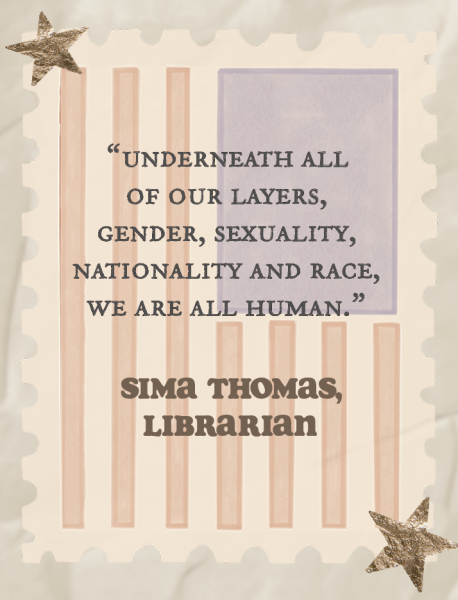
“We really all are, underneath all of our layers, gender, sexuality, nationality and race, we are all human,” Thomas said. “And that’s a universal experience.”
Although America has long dealt with perspectives that struggle to recognize the value that comes from humanity’s differences and similarities, that history does not preclude change. Time and time again, the nation has confronted and revised its own injustices. From the Civil War that ended enslavement to the Civil Liberties Act of 1988, which provided reparations for the incarceration of Japanese Americans during World War II, these achievements illustrate that the normalization of exclusion and injustice can be changed for the better.
“We have so many moments throughout our history where we’ve done so many bad things, but then also had moments where we’ve tried to undo them,” Chang said. “We can be bad, but we can do good and I just hope to see us doing good.”
Through efforts like Paly’s organized ICE protest, Curtis’ petition and Chen’s advocacy, it is evident that transformations are not constrained to the past, but are still actively reshaping American democracy, moving ever closer to the aspirations of the Declaration of Independence.
“Even though at times it might not feel like they’re being respected or protected, these old, dusty documents still matter a lot for us today, and they’re still that North Star for how we as a society function,” Tinsley said. “As long as the government is doing its job, we as people can pursue happiness [and] pursue peace.”
Besides guiding the structure of government, the history of the founding extends far beyond the text of the Constitution and Declaration of Independence, shaping how Americans understand and perceive equality, justice and liberty in their everyday lives. Though these documents may not be consciously present in day-to-day decisions, their influence still remains in how people interact with each other, participate in civic activities and make change. At the same time, American democracy continues to be interpreted and reshaped as society evolves.
“America is an experiment, an ongoing experiment in democratic rule,” Chang said. “I see this as meaning that the country is constantly changing. History shows that truth, great ideals [and] values are attached to early national documents. These are under constant scrutiny, and our understanding of them develops and changes over time, as the country changes socially, culturally, politically and ideologically.”